

SEO for Startups: Cultivating Online Visibility for Emerging Small Business Growth
Startup SEO isn’t a hack, a trick, or a onetime “optimize my homepage” task. It’s the process of turning your website into a predictable growth engine—so the right people find you, trust you, and take action without you paying for every click.
If you’re an emerging small business, the goal isn’t to “rank for everything.” The goal is to earn visibility where it matters most: searches that signal intent (ready-to-buy, ready-to-book, ready-to-compare) and searches that build trust (proof you’re legitimate, capable, and the right fit).
This post will show you how to cultivate SEO like a garden: prepare the soil (technical foundation), plant the right seeds (keywords and pages), water consistently (content), and prune ruthlessly (focus and measurement).
Why Investing in SEO is a Startup Growth Lever (When Done Right)
SEO is one of the few marketing channels where effort compounds. A good page can generate leads for months—or years—without increasing spend every time traffic goes up. For startups and small businesses, that matters.
Why? Because organic search is responsible for 53.3% of all website traffic, making it the single most powerful asset for attracting an audience. Unlike paid ads, which disappear the moment you stop paying, a strong organic presence is a durable, long-term advantage.
For startups, this is critical because:
- Budgets are tight: You need marketing that keeps working long after the initial investment is made.
- Trust is fragile: Buyers want proof before they choose a newer brand. Ranking well in search results is a powerful form of social proof.
- Time is limited: You need a system for growth, not a new “tactic of the week” to chase.
The promise of SEO is transformation: your site becomes your most powerful, automated salesperson—attracting, educating, and converting even when you’re busy running the business.
The 3-Part Startup SEO Framework (Simple, Powerful, Repeatable)

Think of your SEO efforts as building a high-performance engine. Each component is critical; if you skip one, the whole system sputters.
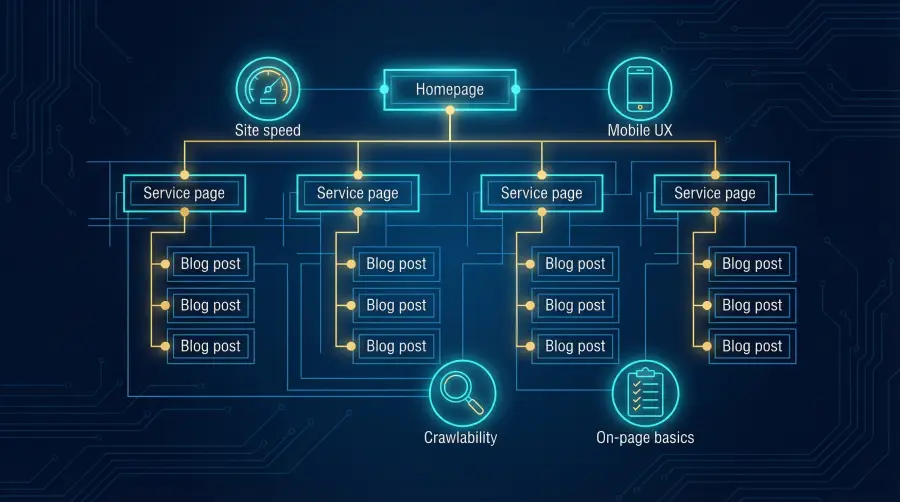
1) Foundation: Make Your Site Easy to Crawl, Fast to Load, and Clear to Understand
Before you can even think about content or backlinks, you must ensure your website isn’t fighting against you. A weak technical foundation will sabotage all your future efforts.
Startup Foundation Checklist:
- Indexing & Crawlability: Your key pages must be discoverable. This means no accidental “noindex” tags, no broken navigation links, and no “orphan” pages that aren’t linked from anywhere else. If Google can’t find it, it can’t rank it.
- Site Speed & Mobile UX: With nearly 63% of global web traffic now coming from mobile devices, a slow or clunky mobile experience is a deal-breaker. In fact, Google’s research shows that 53% of mobile site visitors will leave a page if it takes longer than three seconds to load. Your site must be fast and intuitive on a phone.
- Clean Structure: Your site should have a logical hierarchy with clear categories for your services. Use internal links to connect related pages and establish one primary “home” for each topic to avoid confusing search engines with duplicate content.
- On-Page Basics: Every important page needs a unique title tag, a strong H1 heading, supportive H2s, a descriptive URL, and content that is easy to read.
If you’ve ever felt like “we post blogs but nothing happens,” a crack in this foundation is often the culprit.
2) Relevance: Target Keywords That Match Real Buying Intent (Not Vanity Terms)
Most startups lose at SEO by chasing big, vague keywords like “marketing,” “software,” or “consulting.” These terms are expensive to target (even in terms of effort), hyper-competitive, and often attract users who are just browsing, not buying.
Instead, prioritize keywords that signal a user is close to making a decision:
- “Service + Location” Searches (if you’re local): e.g., “wedding photographer Austin,” “IT support Tampa.” These are some of the highest-converting keywords for local businesses.
- “Problem-Aware” Searches: e.g., “how to fix [common pain point],” “alternatives to [competitor tool],” “best [service] for [specific audience].”
- “Comparison” Searches:“X vs Y,” “best,” “top,” “reviews,” “pricing.”
- “High-Intent” Searches:“book,” “quote,” “near me,” “cost,” “package,” “schedule.”
Rule of Thumb: If a keyword wouldn’t logically lead to a sales conversation, it’s not a priority for a startup.
Jeff Winchester
3) Authority: Prove You’re the Best Answer (With Content + Credibility)
Google’s job is to provide its users with the most helpful, specific, and trustworthy results. In competitive categories, simply having a page on a topic isn’t enough; you have to prove you’re the best answer.
To build authority efficiently, focus on:
- One strong “Pillar Page” per core service: This is your main “money page” that comprehensively covers everything a potential customer needs to know.
- Supporting “Cluster Content”: These are blog posts or articles that answer the specific questions buyers ask before they are ready to convert.
- Proof Assets: These are the trust-builders—case studies, client testimonials, detailed process pages, FAQs, and a compelling ‘About’ page that showcases your team’s credibility.
Authority isn’t just about backlinks from other sites. It’s a combination of clarity, proof, and consistency right on your own website.
The Pages Every Startup Should Build First (In This Order)
If your site is small, you don’t need to start with 50 pages. You need the right pages, optimized to turn visitors into customers.
- 1. Core Service Pages (1 per primary offer): This is your digital sales pitch. It must clearly explain who the service is for, what you do, the outcomes you deliver, your process, and answers to common questions. It must end with a clear, compelling call-to-action.
- 2. A “Results” or Case Study Page: Even one solid, detailed example of your work builds more trust than ten generic blog posts. Show your process and the tangible results you achieved.
- 3. A Strong About Page: Don’t treat this as an afterthought. Tell your story, explain your unique approach, and show the faces behind the brand. This is where you prove why clients are safe choosing you over a more established competitor.
- 4. Local Landing Pages (if applicable): Only create these if you genuinely serve those specific areas. Keep them useful and unique—not just copy-pasted templates. Talk about local projects or your connection to the community.
- 5. A “Start Here” Page (optional, but powerful): For businesses with multiple services or complex offerings, this page acts as a triage system. It helps new visitors quickly find the right next step for them (e.g., book a demo, request a quote, see pricing, take a quiz).
These pages are the foundation for turning SEO traffic into leads. Without them, even top rankings won’t translate into business growth.
Content That Actually Drives Leads (Not “Blogging for Blogging’s Sake”)
![A glowing search bar with search suggestions branching out, including Startup SEO services near me, how to fix [problem], [service] pricing, best [service] for small business, and [competitor] alternatives.](https://mysiteranks.io/wp-content/uploads/2026/02/900px_04_keyword_intent.webp)
For a startup, every piece of content should do one of two jobs:
1. Capture Intent:Attract people who are already searching for a solution.
2. Remove Objections:Convince people who are considering you but aren’t yet sure.
High-Performing Startup Content Formats:
- “Best” and “Top” Lists (when done honestly): e.g., “Best Payroll Tools for Small Teams”
- Alternatives & Comparisons: e.g., “Salesforce vs. HubSpot for Startups,” “Best Mailchimp Alternatives”
- Cost/Pricing Explainers: e.g., “How Much Does a Small Business Website Cost in 2026?”
- Decision Guides: e.g., “How to Choose an SEO Provider (A 10-Point Checklist)”
- Problem/Solution Posts: e.g., “Why Your Website Isn’t Generating Leads (And How to Fix It)”
Pro Move: End every post with a “next step” that logically follows the reader’s intent. If they read a guide on choosing an SEO provider, offer a free SEO audit. If they read about website costs, offer a custom quote. This is how you convert readers into leads.
Local SEO for Emerging Small Businesses (The Fastest Path to Early Wins)

If your business serves a specific geographic area, local SEO can produce momentum much faster than national SEO. The data is clear: 46% of all Google searches have local intent, and while conversion rates vary, recent data shows that 28% of local searches result in a purchase—one of the highest conversion rates of any marketing channel.
Focus your efforts here:
- Your Google Business Profile (GBP): This is your most important local SEO asset. Fill out every section: correct categories, detailed services, a compelling description, high-quality photos, and frequent updates via GBP Posts.
- Reviews: Actively build a simple, repeatable system for requesting reviews from happy customers. Respond to every review—both positive and negative—to show you’re engaged.
- Local Citations: Ensure your business’s Name, Address, and Phone number (NAP) are consistent across all major online directories (like Yelp, Bing Places, etc.).
- Location-Specific Service Pages: Create dedicated pages on your website for your most important service areas. Include real content, local proof (testimonials from local clients), and location-specific FAQs.
For a newer brand, local visibility is credibility. It’s a powerful multiplier.
Conversion Science: The Missing Piece in Most Startup SEO Strategies

Traffic doesn’t pay the bills—conversions do.
When startup SEO “doesn’t work,” it’s rarely a traffic problem. It’s a conversion problem. The site gets visitors, but it fails to convince them to take action because it:
- Isn’t clear about what it does and for whom.
- Doesn’t show proof of its claims.
- Makes contacting you difficult or confusing.
- Feels generic and looks like every other competitor.
Quick Conversion Upgrades That Move the Needle:
- Put a clear outcome promise “above the fold.” Don’t say “Welcome to Our Website.” Say “We Help Plumbers Get 10 New Leads a Month.”
- Add one primary Call-to-Action (CTA) per page. Don’t offer ten choices. Offer the one most logical next step (e.g., Book a Call, Request a Quote, Get a Free Audit).
- Show social proof near your CTAs. Place testimonials, client logos, key metrics, or before-and-after images right next to the button you want them to click.
- Use FAQ sections to handle objections. Proactively answer the questions you know they’re thinking: “How long does it take?” “What does it cost?” “What if I’m not happy?”
This is how SEO becomes a sales engine—predictable, measurable, and scalable.
A Practical 90-Day Plan: SEO for Startups (No Fluff)
Here is a realistic, high-impact plan that a small team can execute.
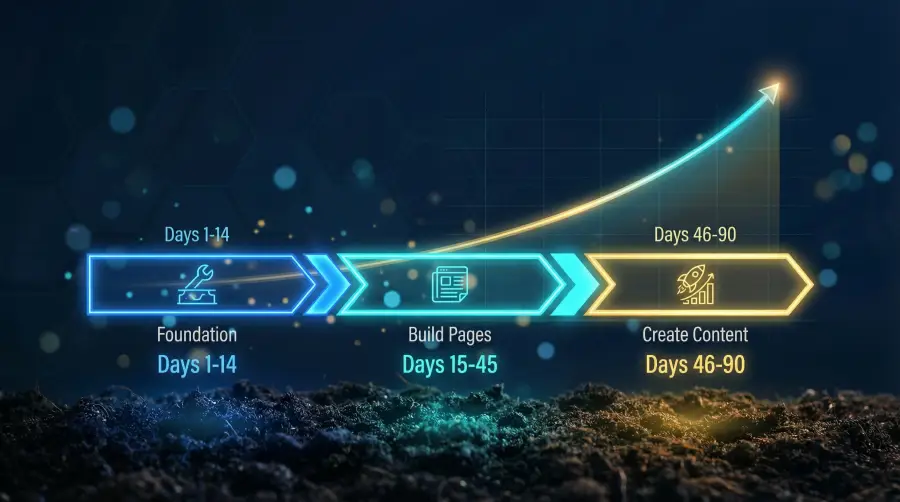
Days 1–14: Set the Foundation
- Fix all major technical blockers (indexing, speed, mobile issues).
- Set up Google Analytics and basic conversion tracking (e.g., form submissions).
- Clarify your core offers and define your ideal customer profile.
Days 15–45: Build Revenue-Driving Pages
- Publish or significantly upgrade your core service pages.
- Add proof: a case study, a handful of strong testimonials, and clear CTAs.
- Create a simple internal linking structure that connects your homepage, service pages, and about page.
Days 46–90: Publish Cluster Content and Build Authority
- Publish 4–8 targeted blog posts that answer key customer questions and handle objections.
- Strengthen internal links from these new posts back to your core service pages.
- Start a light outreach routine: contact 5-10 partners, local organizations, or relevant directories to ask for a link.
- This cadence is realistic, and it compounds. Month after month, the engine gets stronger.
What to Measure (So You Don’t Get Fooled by “SEO Reports”)
SEO should be radically transparent. You should be able to answer these questions at any time:
- 1. Are rankings improving for the keywords that actually matter?
- 2. Is organic traffic to our most important pages (services, booking, contact) increasing?
- 3. Are leads from organic search (forms, calls, bookings) going up, not just sessions?
- 4. Which pages are creating sales opportunities, and which ones are leaking conversions?
If your reporting focuses only on vanity metrics like impressions or overall traffic, it’s not a growth strategy—it’s noise.
Summary: The Path to Predictable Growth
Startup SEO is cultivation, not a quick fix. It requires a commitment to a simple, powerful framework:
• Foundation → Relevance → Authority. Done consistently.
• Build the right pages first. Focus on your service pages and proof before churning out dozens of blog posts.
• Target intent-driven keywords. Create content that captures active buyers and removes their objections.
• Measure what matters. Track leads and revenue signals, not just vanity metrics.
By following this approach, you can transform your website from a digital brochure into your most effective, automated sales engine—one that works for you 24/7, building a foundation for sustainable, long-term growth. At MySiteRanks.io, we do this on a daily basis. Book a free strategy meeting with Jeff by clicking this button.
References
[1] BrightEdge. (2019). Organic Channel Share Expands to 53.3% of Traffic.
[3] Google. (2016, September 8). The need for mobile speed. Google Blog.
[4] HubSpot. (n.d.). 46% of all Google searches are looking for local information.
0 Comments